The Nyoma airfield, which will be one of the world's highest, will sharpen the IAF's capability along the northern border.
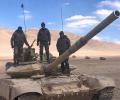
The Indian Army says it wants to deploy the vehicles in places like Eastern Ladakh along with desert and amphibious terrain. The FICV project has been in plans for a long time and the need for a modern troops carrier equipped with tank-busting capabilities was felt during the recent Ladakh conflict.
In a written reply to a question in Lok Sabha, Minister of State for External Affairs V Muraleedharan gave a brief account of the four-month-long standoff and said the Chinese side attempted to transgress the Line of Actual in several areas of the western sector since mid-May.

A Chinese media report said Wei and Singh are attending the event in Moscow and they are likely to meet there over the border tension in eastern Ladakh. "Our Defence Minister would not be meeting the Chinese Defence Minister," Defence Ministry Spokesperson Bharat Bhushan Babu said when asked about the Chinese media report.

L&T was the top gainer in the Sensex pack, soaring around 7 per cent, followed by Bajaj Finance, IndusInd Bank, NTPC, PowerGrid, M&M and Axis Bank. On the other hand, Reliance Industries Bharti Airtel and Maruti were the laggards.

'The government will ensure that India's pride is not affected as far as the situation along Indo-China border is concerned'
"The meeting thus did not result in resolution of the remaining areas," the Army said in a statement.
Monday's clash was the biggest confrontation between the two militaries after their 1967 clashes in Nathu La when India lost around 80 soldiers while over 300 Chinese Army personnel were killed in the confrontation.

Days after a Pentagon report said Beijing built a large village in a disputed territory in the Arunachal Pradesh sector, India on Thursday said it has neither accepted any illegal occupation of its territory by China nor has it accepted unjustified Chinese claims.

'We have to be equally vigilant in the central sector which is where Barahoti lies and also in the Joshimath area.'

Indian troops were maintaining their "posture" along the border with China while infrastructure development in the frontier areas was on track, Army Chief Gen M M Naravane said on Thursday, days after personnel of the two countries were locked in two separate incidents of violent face-offs. Gen Naravane said the incidents in Eastern Ladakh and North Sikkim involved aggressive behaviour by Chinese and Indian troops resulting in minor injuries to personnel from both the sides.
'This strike has certainly enhanced your image.' 'Otherwise, people would have called you a damp squib, capable of doing nothing except talking big.'
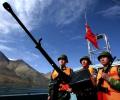
After making incursion bids in Ladakh through land route, Chinese troops have made several attempts to enter Indian waters at Pangong lake nestled in the higher reaches of Ladakh with the latest incident reported on Friday.
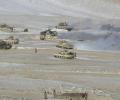
The Indian Army has been pitching for a faster disengagement process in areas like Hot Springs, Gogra and Depsang to bring down tension in the mountainous region.
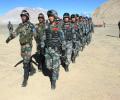
The last time the Chinese military had taken Indian soldiers captive was in July 1962 after a clash in Galwan Valley.

The talks are being held with an aim of resolving the ongoing standoff in eastern Ladakh and reaching an agreement on the last remaining friction point in the Hot Springs area which had emerged post April-May 2020 aggression shown by Chinese troops along the Line of Actual Control (LAC) in Ladakh.
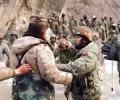
According to the 'Military and Security Developments involving the People's Republic of China' report 2023: "Since early May 2020, sustained tensions along the India-China border have dominated the Western Theater Command's attention."
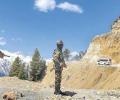
The meeting primarily focused on implementation of certain decisions taken at the fifth round of talks between Corps Commanders of the two armies last week on the disengagement process as well as to bring down prevailing tension in the region, sources said.
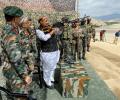
Having already received and deployed the first lot of around 72,500 Sig Sauer assault rifles from the US for counter-terrorist operations, the new batch of these assault rifles would be given to the soldiers deployed on the front with China in Eastern Ladakh.
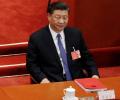
Observers say China should re-address its policies towards India or else it will continue to face flare-ups increasing the tensions between the two countries at a time China's increasing tension with the US over Taiwan and the South China Sea besides the downturn in the Chinese economy which is hit hard by the zero-covid policy.
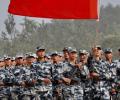
Even though troops of India and China have disengaged at three locations in Eastern Ladakh, the Indian side is clear that the tensions on the borders would be done away completely only when the People's Liberation Army de-inducts more than 10,000 troops along with artillery and tank regiments deployed on its side of the Line of Actual Control near the Indian territory.

'Both sides have agreed that the overall situation should be handled in a responsible manner'

Senior government sources told ANI that one such camp is coming up few kilometres inside the Chinese territory opposite the Naku La area in north Sikkim area, which is barely a few minutes distance from the area where Indian and Chinese troops had clashed last year when the confrontation started and also in January this year.

Rahul Gandhi supports New Delhi's policy of having its relationship with Russia in the context of the Ukrainian war, despite the pressure it feels from the West.

The brother of the martyr, Jai Kishore Singh, who himself is in the armed forces, accused the police of thrashing his father and abusing him.
Talks between the two sides were held on June 6 at the military commanders' level, including the 14 Corps Commander Lt Gen Harinder Singh from the Indian side while the Chinese side was represented by its South Xinjiang Military District commander Major General Liu Lin at Moldo opposite Chushul in Ladakh.

His trip to Moscow comes days after Defence Minister Rajnath Singh visited the Russian capital to attend a meeting of the defence ministers of the eight-nation SCO of which both India and China are members.

India said it is strongly committed to ensuring its sovereignty and territorial integrity.

Twenty Indian Army personnel including a colonel were killed in a clash with Chinese troops in the Galwan Valley in eastern Ladakh on the night of June 15 in the biggest military confrontation between the two countries in over five decades.

Sources indicated that during Saturday's talks, India will insist on a faster disengagement process in remaining areas to bring down tension in the region, which has witnessed a tense standoff between the two militaries for over nine months.
Foreign Secretary Harsh Vardhan Shringla terms India's relationship with China as "complex".
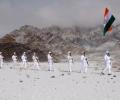
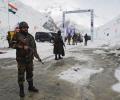
Video footage showed 'Himveers' dressed in white uniforms and chanting slogans of -- Bharat Mata ki Jai and Vande Mataram as the tricolour flies high. Two of the soldiers were seen holding the tricolour as they marched in the snow.

The nearly five-minute video captured glimpses of the lives of soldiers deployed along the ice-capped mountains of the high-altitude region including their round-the-clock vigil, training and combat readiness to deal with any threat.

Col Babu was awarded the gallantry medal for resisting the Chinese Army attack while establishing an observation post in the face of the enemy in the Galwan valley in the Ladakh sector during Operation Snow Leopard.
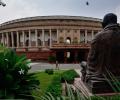
On Day 2 of Parliament's monsoon session 2020, Defence Minister Rajnath Singh is likely to make a statement on the continuing standoff between Indian and Chinese troops along the Line of Actual Control in eastern Ladakh.
When asked for an update on Tuesday's military-level talks, Chinese foreign ministry spokesperson Hua Chunying told a media briefing in Beijing that both sides reached progress for promoting further disengagement of the border troops at the Western Sector.
'The India-China relationship has deteriorated greatly over these past two years and it is set to deteriorate further.'

Singh also said that Indian troops are standing firm braving extreme weather and hostile forces to defend the country's territorial integrity.

New Delhi must clearly demonstrate to Beijing that China will pay a price for its relentless strategic undermining of India, says Ajai Shukla.

For India's sake, please listen to them, Rahul said on
